Do all types of therapy work equally well?

A quick-and-dirty directory of different therapy modalities and their relative strengths and weaknesses, so we can stop competing and start differentiating for greater efficacy.
I love Substack because it is where I interact with people who are passionate about difficult questions in psychology, psychiatry, health, philosophy, and the evolution of ideas about these topics. But I have already grown tired of the therapy wars. There are enough wars in the world. Psychotherapy boasts a dazzling number of ways of working with clients, each with theories that support them. When used well, each “modality,” can be a tremendous force for healing and support.
As a psychologist, I follow many accounts of people writing about mental health on this platform. The accounts I end up unfollowing lose me with their “my therapy is better than your therapy” schoolyard tone. We are all dedicated to helping relieve an iota of the world’s suffering, using whatever implements our field affords us.

I’m not sure if it’s competition for subscribers, something to do with sibling rivalry, or just our tribal nature that causes therapists to become unnecessarily territorial.
It reminds me of my first year in private practice when I worked as an independent contractor in a therapist factory (what else could it be called?) with 75 clinicians across five locations that eventually got swallowed up by LifeStance, a mega-conglomerate mental health provider business that operates in 550 locations across 33 states. My bosses used to get so miffed when I referred patients to therapists outside the practice. I wanted patients to get the best care available with the right clinician for the job. The bosses wanted everyone to be referred in-house.
I believed then, and believe even more strongly now, seventeen years later:
Different kinds of therapy are better and worse for different issues, types of people, or stages of healing.
Watching any master therapist at work, I am regularly amazed at what people in this field are capable of. That is good news! The theories of therapeutic action, or what makes each mode of work actually helpful and healing, are not uniform among these different masters. There is value in this diversity.
There are many common curricular standards in how psychotherapists are trained, but there is no one curriculum for which modalities they learn in graduate school. Programs in psychology, social work, counselors, marriage and family therapy (and the several other designations that allow clinicians to call themselves psychotherapists) have widely differing sets of theories they spend time teaching.
Many training programs teach the basics of Cognitive Behavioral Therapy, some Psychodynamic therapy, and little else in the way of theoretical orientation. My own (excellent) doctoral program included CBT and Psychodynamic training, as well as several types of family therapy, developmental attachment theories, and narrative therapy. There was a single class on “Trauma” but we were not formally trained in any of what are now categorized as the current “trauma treatment” modalities. Like many others, I had to seek out my own extensive post graduate training in order to learn more effective ways of addressing trauma, and helping patients more reliably “get out of their heads.”
The psychotherapy field includes therapists who are trained in only one way of working, as well as clinicians who are exposed to several modalities, and then expected to choose the ones that fit them the best, or come up with some sort of patchwork. How are prospective patients to make sense of this? And how well do therapists distinguish for those prospective patients what kind of therapeutic benefit they are likely to receive from working with them?
Is the relationship all that matters?
Therapists writing about psychotherapy often cite the “common factors” research as a way to simplify and equalize the benefits of therapy as a whole. The meta analyses that comprise this body of work compare several types of therapy and leads many readers to conclude that all therapies are roughly equal in their effectiveness, and the real difference-maker is the therapeutic relationship between patient and therapist. In a beautiful piece describing (in more detail than I’ll get to in this post) how different trauma therapies affect change, Dr. Pria Alpern cites these same findings.1 Alpern states that “Research on the universal factors of psychotherapy consistently finds that treatment method accounts for a surprisingly small percentage of outcome variance.” Alpern’s larger point argues rightly against rigidity in method, and advocates tailoring any modality to the needs of the particular client, especially when trauma is a factor. But when we keep returning to citing these common factors, something critical gets lost. The available data is not sufficiently disaggregated to allow us to compare various treatments in how well they work for specific underlying problems (not merely diagnoses).
It is true that the therapeutic relationship is the strongest predictor of good outcomes overall. And, as Norcross & Lambert state:
The relationship does not exist apart from what the therapist does in terms of method, and we cannot imagine any treatment methods that would not have some relational impact. Put differently, treatment methods are relational acts.2
And
That only tells us that a strong therapeutic alliance is a key ingredient in any good therapy, regardless of modality. What it doesn’t tell us is whether each modality is equally good at treating each type of issue. The studies that the meta analyses are based on don’t sort out that question well enough. I argue that this is where the real differences in effectiveness lies.
I don’t think the general therapy-seeking public has a clear enough framework for knowing what the advantages and disadvantages of different types of therapy are. Why would they? Especially if every school of therapy claims to be “the best.”
Instead of trying to figure out which therapy type is “best,” let’s consider which therapy type or types are “better” for which types of problems and stages of healing.
Which types of therapy are better, and for whom?
I have spent the last twenty-plus years working directly with patients, reading, attending various trainings, consulting on cases, hiring supervisors, and being hired as a supervisor, trying to figure out what works well and what misses the boat in offering meaningful psychotherapy. Many of my own cases have had beautifully successful outcomes, and some did not. The failures were likely because I missed something key in my clinical formulation, lacked certain skills or training in a particular theory or method that would have been useful, used poor timing, or temperamentally, I wasn’t the right fit for the person at that time. I deeply believe that patients cannot fail therapy. Yet it is often difficult for them to find the “right match.”
The following is a summary, in no way comprehensive or complete, of how I view the differential in therapeutic benefit according to types of therapy practiced.
Psychodynamic therapy
Cognitive Behavioral Therapy
So for more immediate change, what about good old Cognitive Behavioral Therapy, the most widely recognized and recommended type of therapy in the U.S. since the 1990s? For people who prefer using logic and learning as the foundation for their work, CBT is often an excellent starting point for therapy.
From the American Psychological Association (one of CBT’s biggest promoters):
Psychological problems are based, in part, on faulty or unhelpful ways of thinking.
Psychological problems are based, in part, on learned patterns of unhelpful behavior.
People suffering from psychological problems can learn better ways of coping with them, thereby relieving their symptoms and becoming more effective in their lives.
CBT addresses unhelpful ways of thinking and patterns of behavior, and attempts to teach new coping strategies. This avenue works really well when the patient is open to learning, and when the problems benefit from being addressed in a direct, consciously chosen manner. Example areas include behavioral health and ADHD coaching, using principles of how we learn, build associations, and form habits to make positive change in these action areas.
Another area where CBT excels is helping people stop behavioral avoidance, a serious factor in both creating and maintaining harmful patterns. Helped along by the bottomless trough of distractions the world offers, avoidance of discomfort or painful emotions can be the root of certain forms of psychopathology. For example, many cases of school avoidance, panic attacks, and irrational fears begin with associations between something painful followed by a temporary reduction in pain or anxiety when the stimulus is removed (or the person gets out of the situation). The cycle of anxiety->avoidance->relief->greater anxiety is one of the most common patterns that any therapist encounters with their patients.
CBT is one of the many therapies that helps people learn not to avoid their pain points, and thus break the problematic association pattern. Exposure with Response Prevention (ERP), a specific form of CBT that is tailored for working with obsessive compulsive disorder and phobias, is an especially successful example of training people to approach rather than avoid discomfort and challenge. CBT often uses a combination of psychoeducation and practice as a primary strategy for therapy.
Mindfulness exercises are easily combined with CBT as part of the practicing. Like digging an irrigation ditch a bit deeper into a hillside to divert the water in a useful direction, each time you deliberately choose a thought or practice a skill, the theory goes, you make that neural pathway more likely to be activated in the future. Repeated practice in both thinking and behavior makes future engagement of more adaptive thoughts and behaviors more likely.
In my experience, this CBT approach can work well, as long as the internal barriers to learning aren’t too high. Creating new stories (inferences and associated interpretations) can happen from new associations, depending on how safe it feels to learn. With those for whom learning doesn’t feel too threatening to their identity or relational capacities, CBT can offer a pretty direct route. Changing thoughts and behaviors involves rewiring those pathways through understanding and practice of something new. That’s true of all therapies, but in CBT it is the main focus.
CBT can be a strong basis for many other therapies to take off from.
But CBT has its limitations. If you are stuck in patterns created in childhood that no longer serve you, CBT might help you learn which of your beliefs are irrational. But if those beliefs were formed in traumatic experiences or emotional wounding from poor attachment relationships, CBT is less likely to help you create new deeply felt beliefs that stick. It might also be experienced as invalidating, sending the erroneous message that with a little practice, it should be easy enough to see the error of one’s thinking and then change it.
For many, CBT is too cognitive and analytical, and people’s emotional protections are much more powerful than their rationality. When CBT isn’t working, many patients are referred to Dialectical Behavior Therapy (DBT).
Dialectical Behavior Therapy
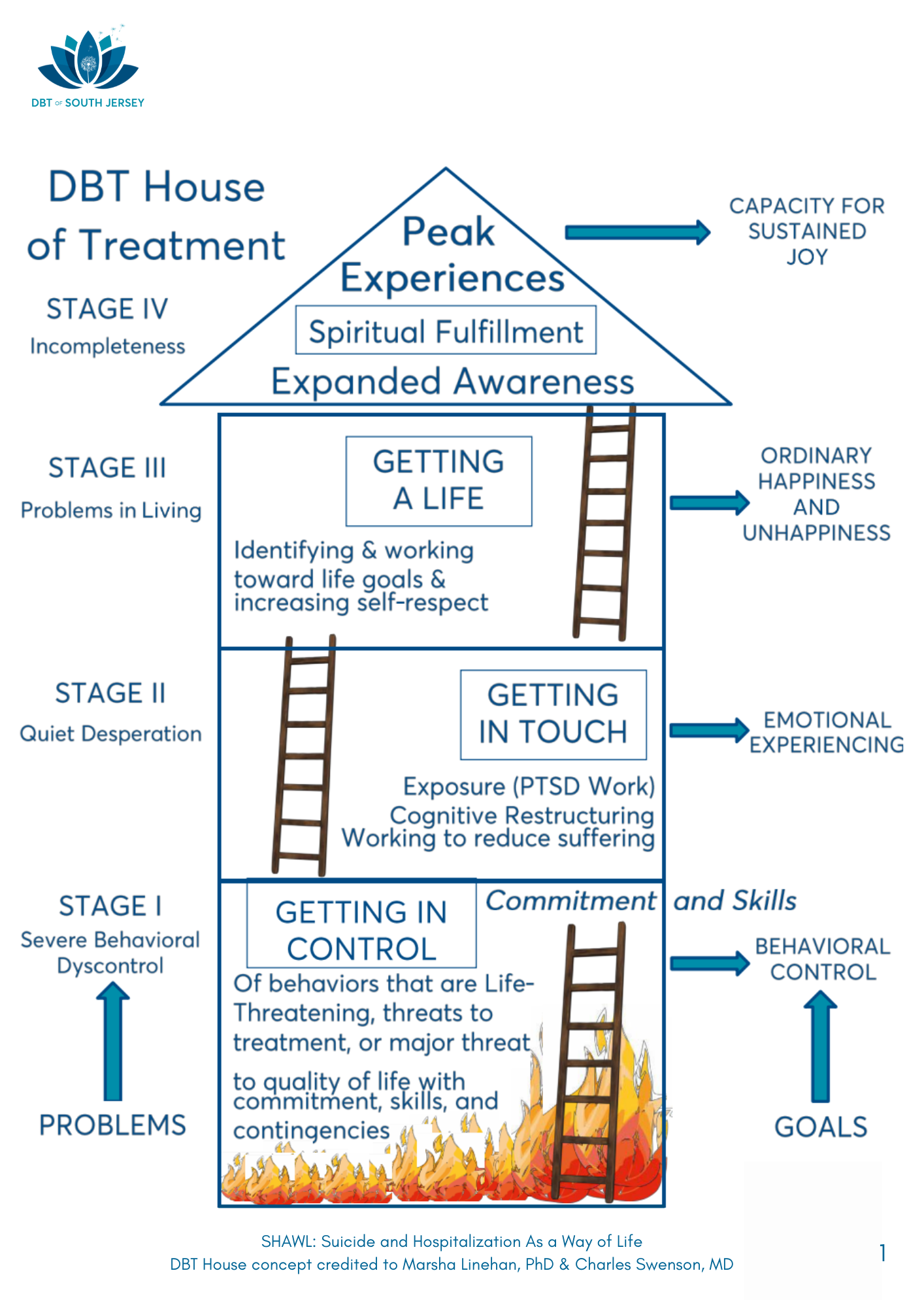
Dialectical Behavior Therapy was developed to treat the patients who were not getting better with the existing psychodynamic and cognitive behavioral treatments. Marsha Linehan, DBT’s founder, personally experienced the failures of these prevailing modalities, as she describes in her memoir Building A Life Worth Living.7Linehan did the heroic work of building a theory and protocol, as well as a research base, that combined aspects of behaviorism with Zen Buddhist concepts. Her aim was to create a program that helped patients who were chronically suicidal, self-harming, and often failed by the mental health systems they interacted with.
When practiced as it was designed, DBT is incredibly helpful for people who are highly sensitive, highly reactive, with a slow return to baseline, and who were brought up in invalidating environments. Those people often experience chronic suicidal ideation, self harm, and may or may not meet criteria for borderline personality disorder. DBT focuses equally on learning and practicing new skills as well as on understanding and validating how a person’s behaviors make sense given their context.
It is not, however, a therapy that heals underlying trauma, and many people who are successful with DBT treatment can still benefit from trauma treatment once they find greater behavioral stability.
Mindfulness skills are a core component of DBT therapy, and mindfulness training such as Mindfulness Based Stress Reduction and Mindful Self-Compassion have become therapeutic modalities on their own. Mindfulness as practiced in most psychotherapy teaches people to pay attention to a given stimulus, and learn to be able to notice that stimulus, separate the noticing from interpretation or judgements about it, and thereby gain enough distance to have more choice in how one reacts. In DBT, mindfulness skills are the first module taught, with the idea that they are the skills that make all other skills learning and implementation possible.
Mindfulness practices are often integrated into other therapy modalities, but mindfulness doesn’t tend to stand alone as an “orientation” or primary theory of how psychological problems develop and how they are healed.
The gaps that Psychodynamic, CBT, and DBT left for newer additions.
Familiarity and confirmation bias can create a kind of superiority complex that unwittingly blinds adherents of any theory to that theory’s own shortcomings. Unfortunately, any established theoretical camp can be quick to criticize newer theories as inadequate and inferior.
CBT (and DBT) proponents claim psychodynamic therapy isn’t “evidence based” enough. Psychodynamically trained therapist Irvin Yalom answers this charge in his book Existential Psychotherapy, stating that when it comes to psychotherapy research, “The precision of the result is directly proportional to the triviality of the variables studied.”8What’s most worth measuring is impossible to accurately measure. These differing frameworks for assessing value can leave the different groups speaking past each other, missing what is most valuable about each, and equally, what is lacking in all.
Indeed, an over-emphasis on studying what can be “objectively” measured leads to a reductionistic view of symptoms, an over-reliance on rating scales, and elevated importance given to verbalizable thoughts and quantifiable behaviors.
Psychodynamic therapy, though it includes a focus on dreams, fantasies, and symbols, can be similar to CBT in its over-prioritizing of “neck up” intellectual work and verbal understanding. Both of these major schools of therapy give insufficient direct attention to work outside of the verbal realm, such as the ways the body holds stress, and how it can regulate stress through movement, singing, rhythm, communal interaction, and physical embodiment.
That gap in attention was begging to be filled, and contributed to the meteoric success of Bessel van der Kolk’s 2014 book The Body Keeps the Score, which began to top the bestseller charts during the coronavirus pandemic. Since then, somatic trauma therapies have proliferated in popularity, and trauma trainings now feel more ubiquitous than Dunkin’ Donuts locations in metropolitan Boston.
If I had a peanut for every continuing education flyer that lands in my mailbox advertising some type of trauma treatment (or, in the past year, psychedelic assisted trauma treatment), I could feed a circus elephant. Someone told me recently she was trying to sell a course on a special topic in therapy, and was told if she wanted to sell, she better put “trauma” in the title.
So what are the various types of trauma therapy particularly good at?
Somatic trauma therapies
Body based, or “somatic” trauma therapies work with the body first – the internal sensations, the breath, the hands on the heart, the movement urges as they are felt, not as they are conceived of. Bessel van der Kolk (like him or hate him) told everyone that for healing trauma, talk therapy is cheap. It may cost sufferers a high price, though, in wasted time and failed expectations.
Grounding in the body with modalities such as Sensorimotor Therapy, Somatic Experiencing, some forms of Gestalt Therapy, Somatic IFS, and Polyvagal Informed Therapy (putting aside the debates about neuroscientific explanations) work well for people who have a hard time calming down, those who quickly collapse into helplessness, or those who are chronically stuck in a fight-or-flight threat response. Somatic trauma therapies increase a felt sense of safety, and have that task as their explicit and primary focus. This is helpful for people who are chronically stressed and hypervigilant, as well as for those on the other end of the spectrum who feel stuck in low-power mode as a way to conserve energy, or who tend to lay low and try not to be noticed as a form of self-protection.
Somatic trauma therapies help the autonomic nervous system resensitize to cues of safety that have been overlooked when eyes and ears get trained into a state of unceasing hyper-alertness. I have come to know people whose systems are so perpetually keyed to threat that no amount of talking, even with a safe other who sees you and treats you with kindness and respect, can bring about lasting change.
This is because some patterns of hypervigilance downplay cues of safety and filter them out of new learning. But with enough somatic re-training, the autonomic nervous system and accompanying prediction circuitry calms down and stops expecting danger at every turn. Only then can other types of therapy yield real fruit.9
Imagination based reprocessing trauma therapies
Another category of therapies under the umbrella of “trauma therapy” are what I call imagination based reprocessing therapies. These siblings to somatic therapies heal through a felt corrective experience, without having to live the correction in real time. Internal Family Systems, Hakomi, and EMDR are imagination-based reprocessing therapies that help people connect to their inner wisdom and capacity for healing and alignment through building inner trust, and then reprocessing difficult material in the context of that new internal relationship. They are remarkably effective at helping people release harmful or limiting beliefs that were learned through intense emotional experience.
By bringing a memory, a problem, or an inner conflict into focus in the here and now, reprocessing therapies facilitate creating new associations that are adaptive, rooted in safety, and flexible. One could argue that when psychodynamic therapies and CBT work well, they are activating this same mechanism, and I might agree.
If you are comparing therapists who are equally well trained, received ample supervision and support, went through their own therapy, and understand their own tender spots and tendencies, all of which is encouraged or required if you go through the full training and certification process for IFS and EMDR, at least, then the differences in effectiveness can be found in the technologies of the therapies themselves.
The imagination based reprocessing therapies have protocols that reliably help people access their memories and conflicts in the therapy office while simultaneously staying rooted in a calm and emotionally nurturing state without going into intellect. That is their benefit. These technologies help the patient stay rooted in a more curious, less constrained mindset (called Self-energy in IFS) that is felt powerfully, using symbols that the patient develops from their own imaginations.
Their appeal also lies in their fundamental non-pathologizing stance that asserts patients already have within them what is needed for healing, and that once safety is established and constraints are removed, healing can happen effortlessly, without having to build or become something different.
In my experience, these approaches on their own work brilliantly for single incident traumas, polarizations between extreme behaviors, more isolated attachment wounds, or traumas that did not pervade every part of a person’s early experience. However, if what ails the patient stems from a pervasive history of frightening or absent relational attachments, imagination based reprocessing therapies alone can be insufficient. If all the patient had were distorting and painful experiences, we arrive again at the need for a long term therapeutic relationship built on trust and careful attention to the relational dynamics that unfold between patient and therapist.
Here we could circle back to a good relational psychodynamic therapy. But we have other options as well. Trauma therapists who specialize in working with complex PTSD, for example, often combine or modify their use of Somatic trauma therapies, IFS, or EMDR with other therapies that give more attention to relational attachment dynamics.
Imagination based reprocessing trauma therapies
Attachment based therapies like attachment-focused EMDR10, or Diana Fosha’s Accelerated Experiential Dynamic Psychotherapy (AEDP), which specializes in “undoing aloneness,” can work more quickly than a typical psychoanalysis (hence, “accelerated”). AEDP combines aspects of psychodynamic therapy with experiential, body-based here and now feeling, and pays extra attention to the felt attachment-related experiences of connection, relief, joy, and other positive emotions as they arise after difficult emotions are fully expressed and brought to conclusion.11
**
So far I have named psychodynamic therapies, cognitive behavioral therapies, somatic based trauma therapies, imagination based reprocessing trauma therapies, and attachment based therapies. As I mentioned at the outset, this is not a comprehensive list. What about narrative therapy, and mentalization therapy, and ACT, and CPT, and… I can’t comment on all of them! But I’d be happy if you’d add your own experiences with each type and what it works best for.
Most real world clinicians do not offer a straight up, single origin serving of therapy. Therapists combine modalities all the time. So much gets worked in as part of the zeitgeist that therapists might not even realize which theoretical ingredients they are combining. An eclectic approach can be helpful. Therapists who draw from many modalities might have a broader range of clients that they are skilled with helping.
But for some of the most sticky problems, the full-strength version of the therapy might be needed. This is where therapists need to recognize their zone of competence and be ready to refer or collaborate when specialized approaches are warranted.
For example, “Adherent DBT” (the full package, as originally designed, with all the rules and structures followed) can help certain people that DBT skills training alone cannot. Watered down versions of IFS such as “parts work” can be more dangerous than helpful if they miss the essential steps of how to build trust between Self (inner source of healing and wholeness) and each part. For the most vulnerable patients, there can be great risk in people thinking they are getting a certain type of therapy, when in fact they are receiving only a derivative or inaccurate version.
It’s tricky (and beyond the scope of this piece) to address this challenge, given that many therapists lack adequate ongoing supervision and most clients don’t have the option to work with the most highly trained adherents of any given therapy. Nevertheless, getting clarity on whether a therapist “pulls from” a certain modality versus whether they were fully trained in it can go a long way if you are looking for a particular kind of help.12
On the flip side of this is the way certain well trained clinicians within every modality take that framework and stretch it or adapt it to work well with their own clients who may fall outside of the original population that the therapy proved itself useful for. Rather than jumping ship, many modality faithfuls expand “the model” to include aspects of other therapies. That makes sense, and underscores my argument that different issues (with distinct underlying causes) require different treatment approaches. When done well, those different approaches can be skillfully blended.
For clients with complex presentations, clinician’s face the important challenge of assessing what type of therapy is needed for effective treatment and in what order. How they make this judgment will depend on which treatments are available in the area and the clinician’s level of familiarity with those treatments. It would be helpful if patients knew up front each of the different types of help that various therapies offer, so they understand the larger plan and how each type can build on the next.13
There is so much more depth to go into about each therapy and the particularities of how they help. I’m currently working on a book about the different types of treatment for depression that work best to address its various underlying dimensions. But the principle holds across modalities — some are better at one thing than another. Some are better suited to particular types of struggles; some are better suited to particular therapists’ personal styles.
I’m excited to learn about more nuances within the theories I’ve mentioned, and to learn about theories I know little of. Feel free to add your own experiences or observations with particular therapies and their strengths in the comments.
If you find any of this useful, please subscribe for more essays (about once every month or so—my writing is slow to percolate and pour) and to be notified when my book comes out. Tentative book title: What’s Getting You Down? A Guide to Matching Effective Treatments for Depression with Root Causes.
1. See Wampold, B. E. (2015). How important are the common factors in psychotherapy? An update. World Psychiatry, 14(3), 270–277. And Norcross, J. C., & Lambert, M. J. (2018). Psychotherapy relationships that work III. Psychotherapy, 55(4), 303–315.
3. ibid.
4. In my five-dimensional framework for depression, attachment wound depression is a meaning-based depression that is rooted in core beliefs about the self, developed in childhood, based on the relational context and the need to make sense of one’s relational pain in a way that the person’s young psyche can tolerate at the time.
5. Of course, other therapies that have similarly intensive and extensive training and supervision requirements, and which also require their trainees to undergo treatment through the same healing process can and do yield similar benefits for their own patients. More about that later.
7. Linehan, Marsha. M. (2020). Building A Life Worth Living: A Memoir. Random House.
8. Yalom, Irvin, D. (1980). Existential Psychotherapy. Basic Books, Inc.
9. Psychedelic assisted therapies, or a treatment called Stellate Ganglion Block or NSR that has been used successfully for PTSD and childhood trauma in the veteran population may have much the same effect on resetting the sympathetic nervous system feedback loop to make way for other types of therapy to become effective.
10. Parnell, Laurel (2013). Attachment Focused EMDR. W.W. Norton & Company.
11. A wonderful book that illustrates AEDP (integrated with aspects of IFS) is It’s Not Always Depression by Hilary Jacobs Hedel (2018).
12. As my colleague Jason Decker pointed out, “Far too many listings on Psychology Today have IFS listed although the person has not undergone training. Ugh!”
13. DBT has a stage model for this called “DBT House of Treatment” that is a welcome example. See https://dbtofsouthjersey.com/wp-content/uploads/2023/10/KSCopyofWelcomePacket.png for a visual.